How to Respond to a Government RFP: A Practical Guide for Small Businesses
Responding to a government Request for Proposal (RFP) is how small businesses win federal contracts. The process is more structured than commercial sales — every solicitation spells out exactly what the agency wants and how they'll evaluate your response. If you follow the instructions precisely and write to the evaluation criteria, you can compete with firms twice your size. Here's how to do it step by step.
This content is for informational purposes only and does not constitute legal, financial, or professional advice. Government contracting regulations, size standards, and procurement procedures change frequently. Verify all information with official sources (SAM.gov, SBA.gov) and consult with a qualified professional before making business decisions.
What Is an RFP?
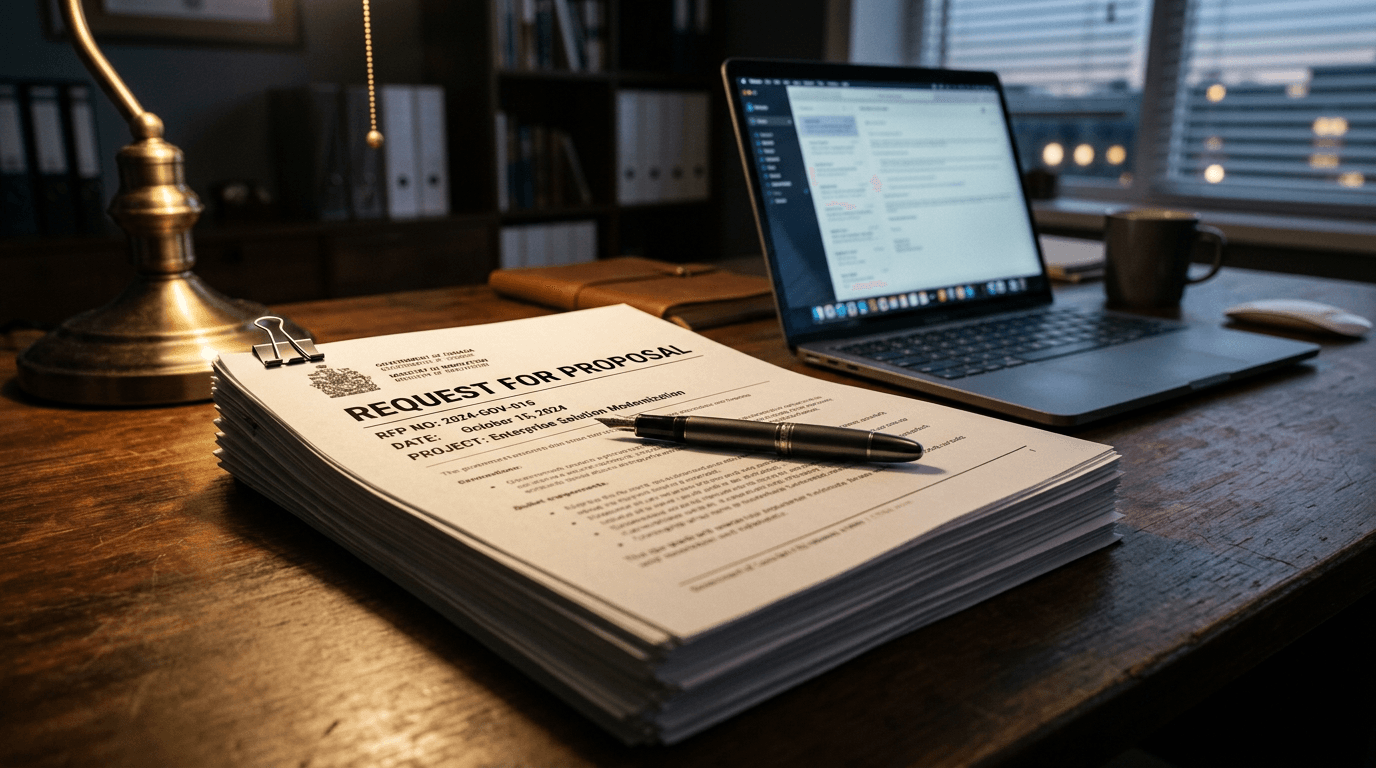
An RFP — Request for Proposal — is a formal solicitation issued by a government agency asking vendors to submit a detailed proposal for a specific project or service. Unlike a purchase order or a quick-turn quote, an RFP requires you to describe your technical approach, your qualifications, and your pricing in a structured document that gets scored against defined evaluation criteria.
Before you start responding to RFPs, it helps to understand how they differ from the other solicitation types you'll see on SAM.gov:
- RFI (Request for Information): The agency is doing market research. They want to know what solutions exist and who can provide them. No contract is awarded from an RFI — but responding to one puts you on the agency's radar.
- RFQ (Request for Quotation): The agency already knows exactly what they want. They need a price. RFQs are price-focused and typically used for commodity purchases.
- Sources Sought: Similar to an RFI, but specifically asking whether small businesses or businesses with particular set-aside certifications can do the work. Agencies use these to determine whether to set aside a contract.
- RFP (Request for Proposal): The agency is ready to buy. They want a full proposal — technical approach, past performance, and price. This is where contracts are won.
The rest of this guide focuses on RFPs, since they're where the money is and where most small businesses get stuck.
Anatomy of a Government Solicitation
Government RFPs follow a predictable structure. Once you've read a few, the format becomes familiar. Let's walk through a hypothetical example: an RFP for IT help desk services at a Veterans Affairs regional office.
Statement of Work (SOW) or Performance Work Statement (PWS)
This is the heart of the solicitation. The SOW describes what the agency needs done. A PWS describes the outcomes they expect. In our VA help desk example, the PWS might specify: "The contractor shall provide Tier 1 and Tier 2 help desk support for 2,500 end users, maintaining a first-call resolution rate of 70% or higher and an average ticket response time of 15 minutes or less during business hours (7:00 AM - 6:00 PM ET)."
Evaluation Criteria
This section tells you exactly how the agency will score your proposal. Most federal RFPs evaluate on three factors:
- Technical Approach — Does your solution meet the requirements? Is your methodology sound?
- Past Performance — Have you done similar work before? Did those clients rate you well?
- Price — Is your pricing competitive and realistic?
Critically, the evaluation criteria section tells you whether this is a "best value" award (where technical quality can outweigh price) or a "lowest price technically acceptable" (LPTA) award (where the cheapest compliant proposal wins). Our VA help desk RFP might say: "Award will be made on a best value basis. Technical approach and past performance, when combined, are significantly more important than price."
FAR Clauses
Every solicitation includes Federal Acquisition Regulation (FAR) clauses — the legal terms and conditions. Most of these are standard boilerplate, but some carry specific compliance requirements. Pay attention to clauses related to labor categories, security clearances, insurance requirements, and reporting obligations.
NAICS Code and Size Standard
The solicitation will list a primary NAICS code and the corresponding SBA size standard. Our VA help desk example might use NAICS 541512 (Computer Systems Design Services) with a $34 million size standard. If your average annual revenue exceeds that threshold, you don't qualify as a small business for this contract.
Due Date and Submission Method
Government deadlines are absolute. If the solicitation says proposals are due by 2:00 PM ET on March 15, your proposal must be received by 2:00 PM ET on March 15. Not 2:01 PM. Most submissions go through SAM.gov or a designated email address. Some agencies still require physical copies — check carefully.
Should You Bid? A Quick Go/No-Go Checklist
Before you invest 40-80 hours writing a proposal, run through these six questions. If you can't answer "yes" to at least five, think hard before committing.
- Right NAICS code? Is the solicitation's primary NAICS code one your business is registered under? If not, you may not be eligible — especially for set-asides.
- Meet the size standard? Confirm your average annual revenue (or employee count, depending on the code) falls under the SBA threshold for this NAICS code.
- Have relevant past performance? Federal evaluators weight past performance heavily. If you've never done similar work, your score will suffer. Subcontracting experience or commercial work in the same domain can partially compensate, but direct government past performance is strongest.
- Can you meet the delivery timeline? If the contract requires full staffing within 30 days of award and you need to hire, can you realistically do that?
- Profitable at a competitive price? Run the numbers. Estimate your costs, add your margin, and ask: is this price competitive for this type of work? If you can't be profitable at a realistic price, walk away.
- Capacity to write the proposal? Writing a federal proposal takes 40-80 hours for a straightforward RFP, and 100+ hours for complex ones. If you're already stretched thin, a rushed proposal will score poorly. It's better to skip one and write a strong response for the next.
How to Write Your Response
You've decided to bid. Here's the process that gives you the best chance of winning.
Read the Entire Solicitation Twice
This sounds obvious, but it's the most common point of failure. Read the entire document — every section, every attachment, every amendment — before you start writing. The first read gives you the big picture. The second read is for details: page limits, formatting requirements, required attachments, specific questions you must answer. In our VA help desk example, the solicitation might require your technical volume to be no more than 25 pages, single-spaced, 12-point Times New Roman, with 1-inch margins. Miss that, and your proposal could be rejected without evaluation.
Build a Compliance Matrix
A compliance matrix is a spreadsheet that maps every requirement in the solicitation to your proposal response. Create three columns: (1) the requirement reference (section and paragraph number), (2) the requirement text, and (3) where you address it in your proposal. For our VA example, one row might be: "PWS 3.2.1 — Maintain first-call resolution rate of 70% — Addressed in Technical Volume, Section 2.1, page 8."
The compliance matrix serves two purposes. First, it ensures you don't miss anything. Second, it becomes a tool your reviewers can use to verify your proposal is complete before you submit.
Write to the Evaluation Criteria
Your proposal isn't a marketing brochure. It's a scored document. The evaluators will assign points based on the criteria listed in the solicitation — and only those criteria. If the evaluation criteria say "technical approach is significantly more important than price," your technical volume needs to be your strongest section. Don't just describe what you can do. Explain why your approach is the best choice, how it mitigates risk, and what specific outcomes the agency can expect.
In our VA help desk example, if one evaluation factor is "Approach to maintaining 70% first-call resolution," don't just say "We will maintain a 70% first-call resolution rate." Instead, describe your tiered support model, your knowledge base strategy, the training program for your staff, and how you've achieved similar metrics on past contracts. Concrete details beat vague promises.
Price to Win
"Price to win" doesn't mean submitting the lowest price. It means submitting a price that's competitive for the evaluation method. In a best-value award, a slightly higher price with a clearly superior technical approach can win over a lower-priced but weaker proposal. In an LPTA award, you need to be the lowest compliant bidder.
Build your pricing from the bottom up: labor rates, materials, travel, overhead, and profit margin. Use the Bureau of Labor Statistics and GSA Schedule rates as benchmarks. If the solicitation includes a government cost estimate, pay attention — it signals what the agency expects to pay.
Get a Review Before Submitting
Never submit a proposal that only one person has reviewed. At minimum, have someone check your compliance matrix (did you address every requirement?), proofread your technical volume, and verify your pricing math. If you have access to a colleague who has won federal contracts, ask them to do a "red team" review — reading your proposal as if they were the evaluator and scoring it against the criteria.
Common Proposal Mistakes
After talking to small businesses who have gone through the federal proposal process, the same mistakes come up repeatedly:
- Missing mandatory sections or attachments. If the solicitation requires a signed SF-1449, a subcontracting plan, or a past performance questionnaire and you don't include it, your proposal may be rejected outright. Use your compliance matrix to catch this.
- Ignoring page limits. If the solicitation says 25 pages and you submit 30, the evaluator is within their rights to stop reading at page 25. Everything after that — including your strongest material — disappears.
- Not directly addressing each evaluation criterion. Evaluators score what they see. If a criterion asks about your quality control process and you don't have a section that explicitly addresses quality control, you'll score low — even if your approach implicitly includes it.
- Submitting late. Federal contracting has zero tolerance for late submissions. If your proposal arrives one minute past the deadline, it will not be evaluated. Period. Submit at least 24 hours early to account for system issues.
- Copy-pasting from previous proposals. Reusing boilerplate is fine for standard sections like company overview or safety plans. But your technical approach must be tailored to this specific solicitation. Evaluators can tell when a response is generic, and it signals that you didn't take the time to understand their requirements.
Finding RFPs That Match Your Business
The best proposal in the world doesn't help if you never find the right opportunities. The federal government publishes all contract opportunities over $25,000 on SAM.gov. You can search manually using keywords, NAICS codes, set-aside filters, and geographic location. But manual searching is time-consuming and easy to miss opportunities — especially when agencies post new solicitations daily.
That's why we built GovConToday. Instead of logging into SAM.gov every morning and running searches, you set your NAICS codes, your preferred set-aside categories, and your target states. Every morning, we pull new opportunities from SAM.gov and send you a digest of the contracts that match your profile. Each listing includes the solicitation title, agency, NAICS code, response deadline, and a direct link to the full solicitation so you can run your go/no-go checklist immediately.
Stop searching. Start responding.
GovConToday matches RFPs to your NAICS codes on your dashboard — so you can spend your time writing winning proposals instead of hunting for opportunities. Start your 14-day free trial — no credit card required.
Start Free TrialKey Takeaways
- An RFP is the government's way of asking for a full proposal — technical approach, past performance, and price. It's where contracts are won.
- Every solicitation follows a predictable structure: Statement of Work, evaluation criteria, FAR clauses, NAICS code, and deadline. Learn the anatomy and you'll read them faster.
- Run a go/no-go checklist before investing proposal time. The right NAICS code, relevant past performance, and realistic pricing are non-negotiable.
- Build a compliance matrix mapping every solicitation requirement to your response. This is the single most effective tool for avoiding disqualification.
- Write to the evaluation criteria, not to your own marketing talking points. Evaluators score what the solicitation tells them to score.
- Submit early. Federal deadlines are absolute — there is no grace period and no exception process for late proposals.
- Use NAICS-based matching to find relevant RFPs automatically instead of manually searching SAM.gov every day.