Government Set-Aside Programs Explained: 8(a), WOSB, SDVOSB, HUBZone & More
Set-aside programs are the federal government's primary mechanism for directing contract dollars to small businesses. In fiscal year 2024, the government awarded a record $183.5 billion in contracts to small businesses — over 28% of all federal prime contracting dollars, including $69.6 billion through small business set-asides alone. If you're a small business owner and you're not leveraging set-asides, you're competing in an open field where you don't have to.
This content is for informational purposes only and does not constitute legal, financial, or professional advice. Government contracting regulations, size standards, and procurement procedures change frequently. Verify all information with official sources (SAM.gov, SBA.gov) and consult with a qualified professional before making business decisions.
What Are Set-Aside Programs?
A set-aside is a contract opportunity that the federal government reserves exclusively for a specific category of small business. When a contracting officer "sets aside" a procurement, only businesses that meet the program's eligibility requirements can submit bids. Large businesses and non-qualifying small businesses are excluded from competing.
The legal foundation is straightforward: under the Small Business Act, the federal government has a statutory goal of awarding at least 23% of all prime contract dollars to small businesses. Within that 23%, there are specific sub-goals for different program categories — 5% for small disadvantaged businesses (which includes 8(a) firms), 5% for women-owned small businesses, 5% for service-disabled veteran-owned small businesses (raised from 3% by the FY2024 NDAA), and 3% for HUBZone businesses.
These aren't suggestions. Federal agencies are measured against these targets every year, and agency heads report their scorecard results publicly through the SBA. This creates real institutional pressure to find and award contracts to qualifying small businesses — which is exactly why set-asides exist. They're the mechanism agencies use to hit their numbers.
If you're new to government contracting, our guide to finding government contracts for small businesses covers the basics of getting started, including SAM.gov registration and finding your first opportunities.
Types of Set-Aside Programs
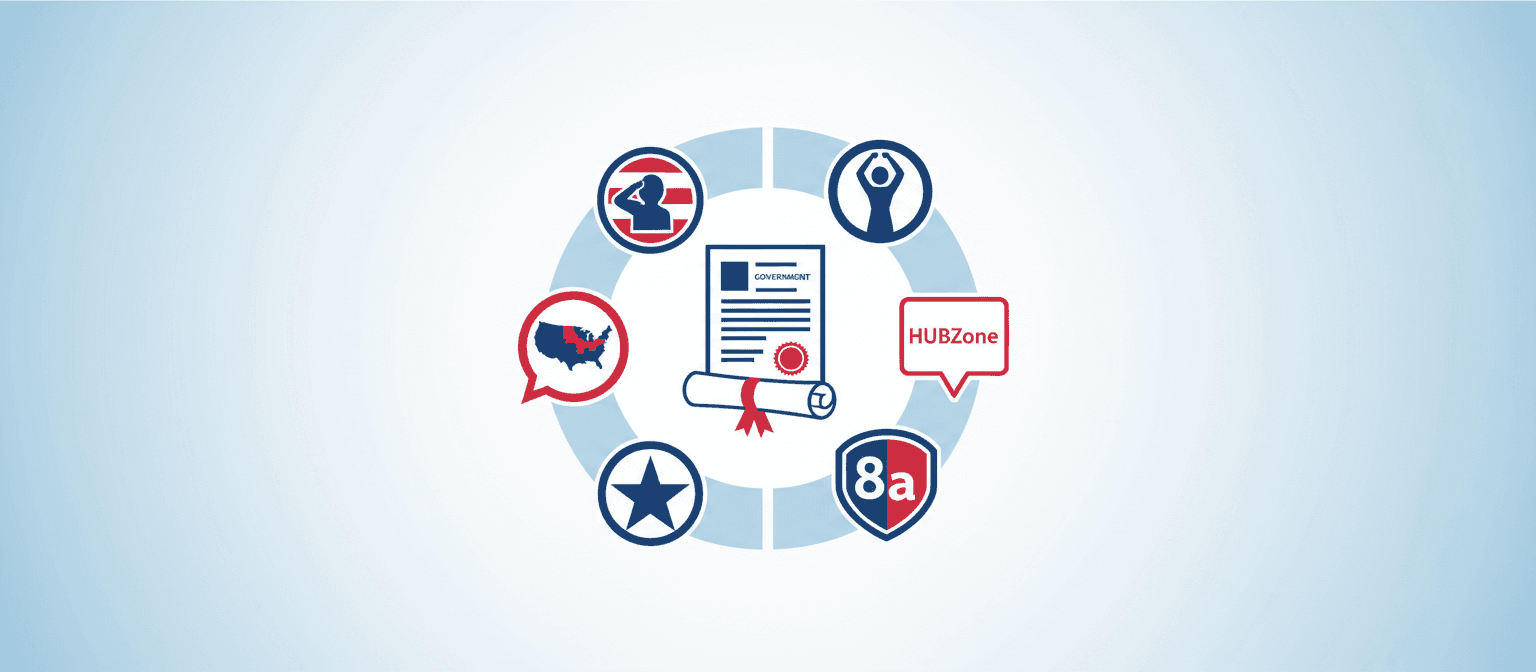
There are five main set-aside categories you'll encounter on SAM.gov. Each has different eligibility requirements, certification processes, and contracting rules.
Total Small Business Set-Aside (FAR 19.5)
This is the broadest and most common set-aside type. Any business that qualifies as "small" under the SBA size standard for the contract's NAICS code can compete. There is no special certification required beyond having an active SAM.gov registration and meeting the size standard.
Contracting officers are required to set aside acquisitions for small businesses when there is a reasonable expectation that at least two responsible small businesses will submit competitive offers. In practice, this means a huge volume of contracts under $350,000 are automatically set aside — the simplified acquisition threshold (raised from $250,000 effective October 1, 2025) effectively presumes small business set-aside for anything below that amount.
Total small business set-asides represent the largest share of set-aside contract dollars. If you qualify as small under your NAICS codes and you're registered on SAM.gov, you're already eligible.
8(a) Business Development Program
The 8(a) program, administered by the SBA, is a 9-year business development program for small businesses owned and controlled by socially and economically disadvantaged individuals. The name comes from Section 8(a) of the Small Business Act.
Who qualifies: The business must be at least 51% unconditionally owned and controlled by one or more socially and economically disadvantaged U.S. citizens. The owner's personal net worth must be below $850,000 (excluding the value of the business and primary residence), and the business must have been in operation for at least two years. The SBA evaluates social disadvantage based on race, ethnicity, gender, physical handicap, or other documented circumstances.
Certification body: SBA directly. The application process takes 90 days on average, though it can take longer.
Program structure: The program runs for 9 years total — a 4-year developmental stage followed by a 5-year transitional stage. During the developmental stage, 8(a) firms can receive sole-source contracts (no competitive bidding required) up to $5.5 million for services or $8.5 million for manufacturing. This sole-source authority is one of the most powerful advantages in government contracting. During the transitional stage, more contracts must be competed.
Approximately 5% of all federal prime contract dollars are targeted for small disadvantaged businesses, and 8(a) is the primary vehicle for meeting that goal.
Women-Owned Small Business (WOSB) and Economically Disadvantaged Women-Owned Small Business (EDWOSB)
The WOSB and EDWOSB programs set aside contracts for women-owned firms in industries where women are underrepresented in federal contracting.
Who qualifies (WOSB): The business must be at least 51% unconditionally and directly owned and controlled by one or more women who are U.S. citizens. The women must manage day-to-day operations and make long-term decisions for the business. The business must be small under the applicable NAICS code size standard.
Who qualifies (EDWOSB): Same as WOSB, plus the women owners must demonstrate economic disadvantage — personal net worth below $750,000, adjusted gross income averaging $400,000 or less over three years, and total assets below $6.5 million.
Certification body: SBA directly, or through an SBA-approved third-party certifier. Self-certification is no longer accepted — as of 2023, all WOSBs must be formally certified.
Contracting rules: WOSB set-asides are limited to industries where the SBA has determined women are substantially underrepresented. EDWOSB set-asides apply in industries where women are underrepresented. WOSB contracts can be sole-sourced up to $5.5 million for services and $8.5 million for manufacturing. The government's goal is 5% of federal prime contract dollars to women-owned small businesses.
Service-Disabled Veteran-Owned Small Business (SDVOSB)
SDVOSB set-asides are reserved for small businesses owned and controlled by service-disabled veterans.
Who qualifies: The business must be at least 51% owned and controlled by one or more service-disabled veterans. A "service-disabled veteran" is a veteran with a disability incurred or aggravated in the line of duty in the active military, naval, or air service, as documented by the VA. The disability does not need to be combat-related — it can be any service-connected disability rating.
Certification body: SBA's Veterans Small Business Certification program (VetCert). As of January 2023, all SDVOSBs must be certified through VetCert to compete for SDVOSB set-asides. Previously, self-certification was sufficient for non-VA contracts, but that is no longer the case.
Contracting rules: SDVOSB contracts can be sole-sourced up to $5 million for services and $8.5 million for manufacturing. The federal goal is 5% of all prime contract dollars to SDVOSBs. The Department of Veterans Affairs has historically been the largest user of SDVOSB set-asides, but all federal agencies can use them.
HUBZone Program
The Historically Underutilized Business Zone (HUBZone) program directs contracts to small businesses located in — and employing people from — economically distressed areas.
Who qualifies: The business must be small under SBA size standards, its principal office must be in a designated HUBZone, and at least 35% of its employees must live in a HUBZone. The business must be at least 51% owned and controlled by U.S. citizens, a Community Development Corporation, an agricultural cooperative, an Indian tribe, or a Native Hawaiian organization.
Certification body: SBA directly. You can check whether an address falls within a HUBZone using the SBA's HUBZone map tool. Certification requires documentation of employee residency and principal office location.
Contracting rules: HUBZone firms receive a 10% price evaluation preference in full and open competition (meaning their bid is treated as 10% lower than it actually is). HUBZone contracts can be sole-sourced up to $5.5 million for services and $8.5 million for manufacturing. The federal goal is 3% of prime contract dollars to HUBZone firms — though historically this has been one of the hardest targets for agencies to meet.
How Set-Asides Appear on SAM.gov
When you search for contract opportunities on SAM.gov, the set-aside type is listed as a distinct field on every solicitation. In the SAM.gov data model, this is the typeOfSetAside field (sometimes displayed as "Set-Aside" or "Type of Set-Aside" in the opportunity details).
The most common values you'll see:
- "Total Small Business Set-Aside (FAR 19.5)" — Open to all qualifying small businesses
- "8(a) Set-Aside" or "8(a) Competed" — Restricted to SBA-certified 8(a) firms; "competed" means multiple 8(a) firms bid, as opposed to a sole-source award
- "8(a) Sole Source" — Direct award to a specific 8(a) firm without competition
- "Women-Owned Small Business" — Restricted to certified WOSBs in eligible NAICS codes
- "Economically Disadvantaged Women-Owned Small Business" — Restricted to certified EDWOSBs
- "Service-Disabled Veteran-Owned Small Business" — Restricted to VetCert-certified SDVOSBs
- "HUBZone Set-Aside" — Restricted to SBA-certified HUBZone firms
- "Partial Small Business Set-Aside" — Some portions reserved for small business, others open to all
When filtering on SAM.gov, you can select one or more set-aside types from the "Type of Set-Aside" dropdown in the Contract Opportunities search. This is one of the most effective filters for narrowing results to contracts you can actually win. Combining set-aside type with your NAICS codes and place of performance gives you a highly targeted search.
Common Mistakes with Set-Asides
Not Getting Certified Before Bidding
This is the most expensive mistake. A business submits a proposal for an 8(a) set-aside or SDVOSB contract, wins the evaluation, and then discovers they can't receive the award because they aren't certified. Certification must be in place at the time of offer and at the time of award. The 8(a) application alone takes an average of 90 days. SDVOSB VetCert can take 60-90 days. WOSB certification can take 2-4 weeks through a third-party certifier. Start the certification process well before you plan to bid.
Assuming All Small Business Contracts Are Set-Asides
They're not. Many contracts are issued as "full and open competition" with no set-aside, meaning large businesses can bid too. A small business can still compete on these, but you won't have the competitive advantage of restricted competition. Don't assume that being small is enough — check the set-aside field on every opportunity you evaluate.
Ignoring Sole-Source Thresholds
Each set-aside program has sole-source authority up to specific dollar thresholds: $5.5 million for services ($5 million for SDVOSB) and $8.5 million for manufacturing across 8(a), WOSB, SDVOSB, and HUBZone programs. Below these thresholds, a contracting officer can award directly to a qualified firm without competition. Many small businesses don't actively pursue sole-source opportunities, leaving significant money on the table. Building relationships with contracting officers and making them aware of your certifications is how sole-source awards happen in practice.
Not Tracking Certification Expiration
Certifications aren't permanent. The 8(a) program runs for exactly 9 years. HUBZone certification requires annual recertification and can be lost if your principal office moves or your employee residency percentage drops below 35%. WOSB and SDVOSB certifications must be renewed periodically. If your certification lapses, you lose eligibility for set-aside contracts immediately — even if you're in the middle of pursuing an opportunity. Put renewal dates on your calendar at least 90 days in advance.
How GovConToday Filters by Set-Aside
When you create your GovConToday profile, you select which set-aside programs you're certified for. Every morning, when we pull new opportunities from SAM.gov and build your matched results, we match the typeOfSetAside field against your certifications. If you're an 8(a)-certified firm, you'll see both 8(a) set-asides and Total Small Business set-asides in your digest — because you're eligible for both. The digest clearly labels each opportunity's set-aside type so you can prioritize the ones where you have a competitive advantage. Combined with NAICS code matching and geographic filtering, this gives you a daily pipeline of contracts you can actually win. Sign up free to try it.
Match contracts to your certifications automatically
GovConToday filters SAM.gov opportunities by your set-aside certifications, NAICS codes, and target states — then delivers matched contracts to your dashboard. Start your 14-day free trial — no credit card required.
Start Free TrialWhich Set-Aside Program Should You Apply For?
Choosing the right set-aside program depends on your ownership, location, and veteran status — not on what type of work you do. Every set-aside program is available across all industries and NAICS codes. Here is a quick decision framework:
- Everyone: Total Small Business set-asides require no special certification beyond being small under the contract's NAICS code and having an active SAM.gov registration. If you're a small business, you're already eligible.
- Socially disadvantaged owners: Apply for 8(a). The 9-year program offers the most powerful contracting advantages, including sole-source awards up to $5.5 million. Start early — the application takes about 90 days.
- Women owners: Apply for WOSB certification. If you also meet the economic thresholds, apply for EDWOSB to access a larger pool of designated NAICS codes.
- Service-disabled veterans: Apply for VetCert (SDVOSB). The VA has especially strong SDVOSB preferences, making it a high-value certification for firms targeting VA work.
- Located in economically distressed areas: Check the SBA HUBZone map. If your principal office and 35% of employees qualify, apply for HUBZone certification. The 10% price preference on full-and-open competitions is an underappreciated advantage.
You can hold multiple certifications simultaneously — an 8(a) firm that also qualifies as WOSB and is in a HUBZone can compete for all three types of set-asides. Stacking certifications maximizes the pool of restricted contracts available to your business. Once you're certified, use a tool like GovConToday to automatically surface set-aside contracts matched to your certifications every morning.
Key Takeaways
- Set-aside programs reserve federal contracts for specific categories of small businesses. The government's statutory goal is at least 23% of prime contract dollars to small businesses, with sub-goals for each program.
- The five main programs are Total Small Business, 8(a), WOSB/EDWOSB, SDVOSB, and HUBZone. Each has different eligibility requirements and certification processes.
- Certification must be in place before you bid. Start the application process months before you plan to pursue set-aside contracts — 8(a) alone takes about 90 days.
- Sole-source authority is a major advantage. Under roughly $5-5.5 million (services) or $8.5 million (manufacturing), contracting officers can award directly to a certified firm without competition.
- On SAM.gov, filter by "Type of Set-Aside" combined with your NAICS codes to find the contracts where you have the strongest competitive position.
- Track your certification renewal dates. A lapsed certification means immediate loss of set-aside eligibility.